WizNet WIZ820io – plug in and go?

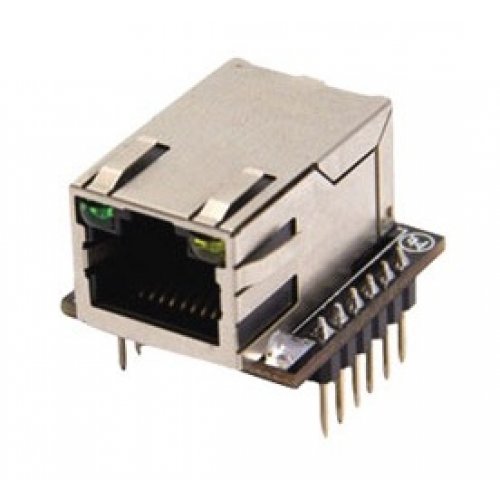
A little while back, I was musing upon the desirability of  the new WizNet WIZ820io ethernet breakout board. It’s a magjack and W5200 chip combination that (in theory) allows you to simply add network connectivity to your projects with a few SPI connections and a slightly modified version of the standard Arduino Ethernet library. At the time I was looking, the only place I could find selling them in the…
Time – He’s waiting in the wings

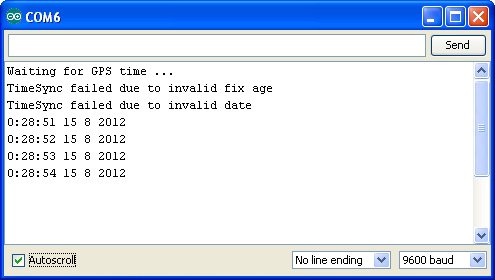
Whilst in the middle of something else (about which I shall no doubt witter on at great length on a later occasion) I found that I needed to set an Arduino’s system clock based upon NMEA data coming from a GPS receiver. No problem thinks I … there’s that handy example in the Time library in the arduino.cc playground – I’ll use that and be done in a jiffy. Have…

Wantage : WizNet WIZ820io

In one of those cases where you see the same thing mentioned in two completely different places on the Internet on the same lazy Sunday afternoon – and the second time you see it just reinforces the opinion from the first time – I’m on the lookout for a UK distributor carrying the new(ish) WizNet WIZ820io plug-in network module. It’s a breakout board with an RJ45 magjack and a W5200…

Codebender – yay or nay?

I saw the recent announcements of a new online IDE for Arduino development called Codebender and thought it sounded interesting, so I signed up to pre-register for a beta account (in the way that you do, these days). The basic idea is simple; the IDE is “in the cloud” (or online as it used to be called) and so is your code. Thus, wherever you have access to a browser…

No fuss Nanode

After all the recent fun I had trying to get a Xino Basic and ENC28J60 ethernet shield (remember they’re both from Ciseco, mind) running together from an external PSU, I was left wondering if there might possibly have been a similar path I could have taken that would involve a little less pissing about with regulators that aren’t up to the job. Staying on the same “indie” side of the…

Wantage : Standuino

It’s a Standuino. As soon as I saw this Arduino – alike from Czech artist Standa Filip it went straight onto my mental “I need to buy that” list. Whilst I don’t mind the 15 euro price tag, I’m not too keen on the 7 euro postage charge for just one kit. Guess I’ll have to wait for a nice UK distributor to get a stock of them. It’s your…

Assembling the CurrentCost interface

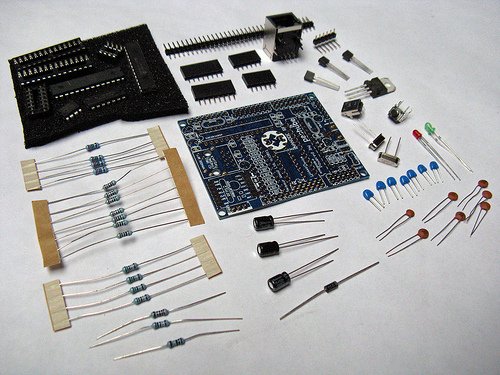
With a CurrentCost energy monitor of any form, there’s a variety of ways that you can track historical data; Option 1 involves simply looking at the stored summary on the unit itself. It’s interesting for about the first seventeen seconds, but you have no context to what you’re seeing and ultimately no ability to compare year-on-year data, say. All you can do is watch it scroll through the average KWhr of energy…

What’s the time, Mr Wolf?

If you’ve got an Arduino and an ethernet connection, you can use one of the many public Network Time Protocol (NTP) servers to find out the current time. This can remove the need for adding a realtime clock module to your project, as you can check the time in your initial setup and then re-check (and reset) at regular intervals to account for any vagueness in the inbuilt millis() based timekeeping.…

Measuring the current draw of an Arduino project

A number of times I’d seen Arduino folks casually say “just measure the current draw of your project” when discussing some technical aspect or another, but in all honestly until recently, had only the vaguest clue what they were on about. There’s a number of great articles online about how to test a generic circuit with a multimeter, but they seem to skip over actually measuring the draw of an…

There’s something wrong with my Stash

Since the weekend I’ve been trying to work out why the code to upload data to my Cosm feed was falling over after random periods of time. Sometimes it lasted for a few hours before dying, but others it lasted just minutes. There was no readily visible pattern, so it was time to get Googling and also accumulate a bit more data so I could get a better handle on…

Finally uploading some CurrentCost data

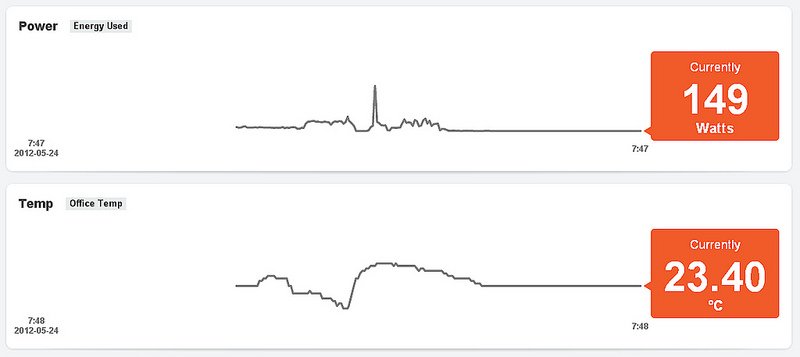
Having established how to power my CurrentCost monitor, the next step was to start using an Arduino to upload the data to one of the many Internet of Things (or IoT) data bucket sites out there and – for a first step – Cosm (what used to be called Pachube) seemed like as good a starting point as any. The above graphs are generated using PachuBlog (which will no doubt get renamed CosmBlog…

First steps with a GPS module

A while back I saw a new product on Adafruit’s blog and instantly thought “I gotta get me one of those!” Its official title was “Adafruit Ultimate GPS Breakout – 66 channel w/10 Hz updates – MTK3339 chipset” and the feature list just kept on scrolling down the page. Now, I’ll be the first to admit that I had no immediately obvious plans for connecting an Arduino up to a…

Turning the power problem on its head

Regular readers will remember I’d previously had a problem trying to run an Arduino from the power line of a CurrentCost CC128 energy monitor using the CurrentCost’s own PSU for both devices, wherein as soon as you connected the additional load of an Arduino, the CurrentCost stopped getting readings from its remote sensor. The reason for wanting to do this – I should point out – is that it seems…

Do you want fries with that?

Here’s a little tip for you; if you’re experimenting with an Arduino and a CurrentCost, trying to see if you can power one from the other and you have the 3.3v pin on the Arduino connected to the unregulated power line on the CurrentCost’s interface port, don’t then have a brain fade and plug the CC128’s PSU back in … It’s fried something on the Uno with the upshot being…

Implementing a web app

As part of a “grand plan”, I’m thinking about how to implement a feature rich Arduino web application, without getting myself tied up in knots worrying about blowing the capabilities of the ATmega in terms of program size, memory size or processor speed. Without an SD card to store all the files on, the simple logical answer is to hand off as much work as possible to “someone else”, so…