After all the recent fun I had trying to get a Xino Basic and ENC28J60 ethernet shield (remember they’re both from Ciseco, mind) running together from an external PSU, I was left wondering if there might possibly have been a similar path I could have taken that would involve a little less pissing about with regulators that aren’t up to the job.
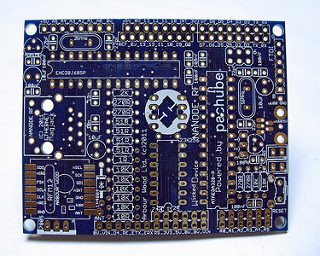 Staying on the same “indie” side of the Arduino fence is the Nanode, an Arduino-alike with on-board ethernet that came out of work at the London Hackspace. Both come in kit form, can operate at either 5 or 3.3V and use the same ethernet chip, whilst the Nanode offers some additional memory and has space for mounting an RFM12B wireless module. The Xino’s got a little prototyping area and the Nanode’s got a mini-USB power connector – you could get carried away comparing everything but it’s basically swings and roundabouts. I’ve set out below the comparative costs to get to the same endpoint; the stackable header kit is included as the ethernet shield doesn’t have through headers as standard and the LM7805 regulator is there because the 5V reg in the kit only passes a max of 100mA, whereas the shield draws around 200mA.
| Xino Basic + ENC28J60 shield | Nanode Classic | ||||||||||||
|---|---|---|---|---|---|---|---|---|---|---|---|---|---|
|
£ 25.00 |
Hmm, I didn’t think it would be so close …
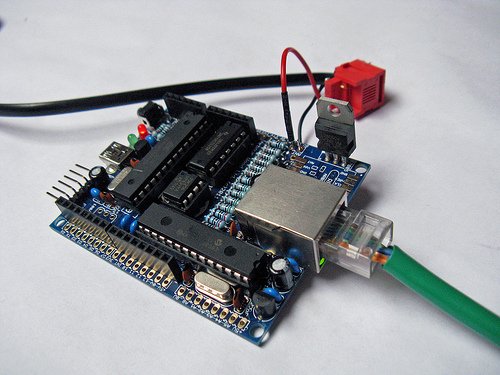
Building the Nanode
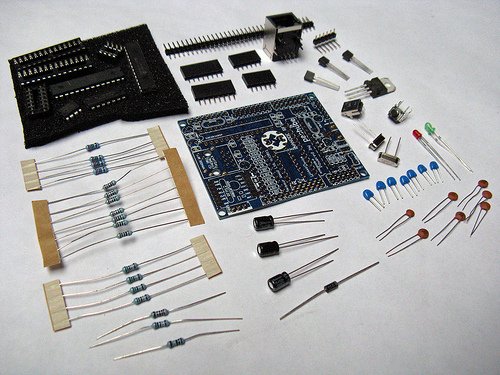 It’s all what I now think of as “pretty standard stuff” with your bare PCB, resistors, capacitors, LEDs, crystals, voltage regulators, headers and chips – just add solder. The build guide is pretty comprehensive and a good frame of reference for a novice; particularly the reminder to use a multimeter to differentiate the 1Ω and 10Ω resistors – if I’d relied on the lighting in my study I would have got it wrong.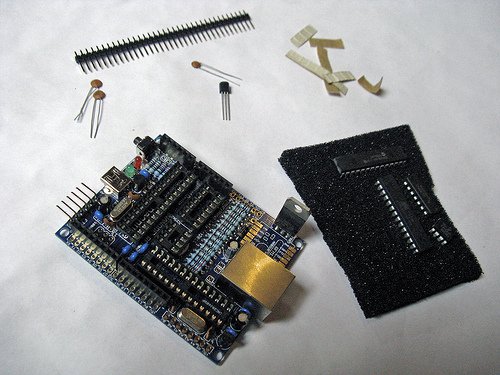
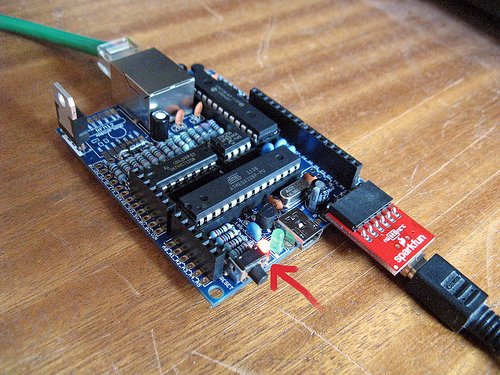
So what’s the conclusion then?
I guess I gave the game away with the post title, really. In terms of simply getting the job done, then – on the face of it – the Nanode looks like a straight winner, however, to be fair to the Xino I’m not sure how much of the straightforward-ness of the Nanode’s build was down to what I’d learnt with the Xino. If I had never done the Xino, would the Nanode have been so simple? In all honesty, I don’t know – but I do know that it felt like less hassle.
Which would I use going forwards then? For the sake of a couple of quid cost difference, the Nanode is the winner if what you’re after is an ethernet connected Arduino-alike. If you don’t need the ethernet, however, the Xino is great for giving you something you can just put into a finished project, without the extra cost of buying an actual Arduino Uno, say.